Connecting design and engineering through delivery
Defining decisions, ownership, and validation before implementation.
Product work reached development with unresolved requirements and design questions. I introduced App and Web Design Sprint agreements across product, BA, design, engineering, and QA.
The agreements defined what each team needed to provide before work moved to the next stage.
At a glance
- 10 → 7 days
- Recorded release gap
- DevOps adopted
- Workflow extended beyond design
- Earlier validation
- UX checks before development
Problem
Too many questions came up too late
Across six consecutive product meetings, requirements, approvals, and user stories were still being revised during delivery. Developers and QA were discovering basic product questions after implementation had begun.
Solution
Define readiness, then scale the process to the work
I defined what “ready” meant at each stage. Product owners set direction, BAs owned detailed requirements, design specified the experience, and engineering and QA joined early to resolve feasibility and testing questions.
I then reduced the process for smaller improvements. Large, uncertain features kept discovery and validation steps; familiar changes could move through a lighter workflow.


 The basic workflow put feature exploration and ownership before implementation.
In practice
Systems > meetings
I later applied the same approach to AI-assisted implementation. Confluence held product intent, Jira held executable scope, Figma specified the experience, and code reused the shared tokens and components. QA and PostHog provided checks after implementation.
When implementation exposed an ambiguous rule, I corrected both the project and the shared guidance. The next build could start with that decision already made.
Outcome
The release gap narrowed and DevOps adopted the workflow
The release report recorded gaps of 10, 9, and 7 days across three successive releases—a 30% reduction from the first to the last. Security work, regression testing, and QA capacity also influenced the schedule, so this was a shared delivery result.
DevOps adopted and adapted the workflow for larger and smaller features. The agreements extended beyond design into how the team prepared and validated work.

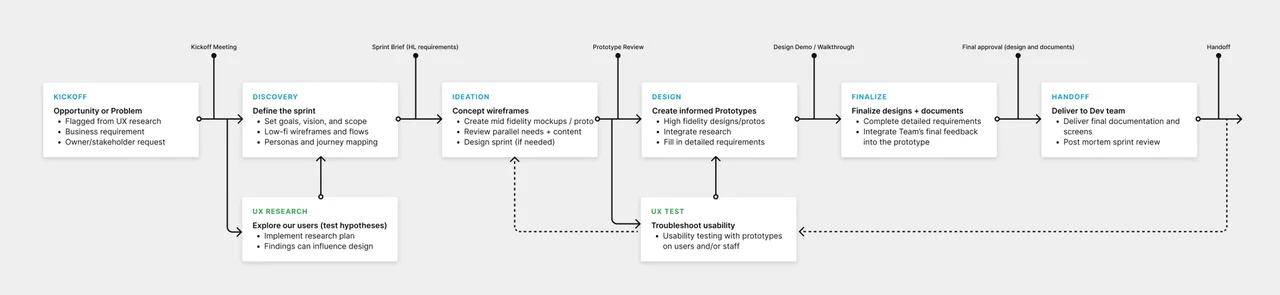 Larger features added UX validation before handoff.
